23.6.13

Decimo articulo en Ciudad Viva - “Beds in Shed” Las nuevas viviendas informales en la ciudad global

Mi ultima aportación a la publicación web La Ciudad Viva es un articulo sobre las nuevas viviendas informales en el extrarradio de Londres que ponen en entredicho la vivienda suburbana como tipologia que puede absorber mayores densidades de población inmigrante en ciudades globales como Londres. http://www.laciudadviva.org/blogs/?p=17714

My last contribution to Web publishing La Ciudad Viva is an article about the new informal housing on the outskirts of London that critically assesses suburban housing as a typology able to  absorb higher densities of immigrant population in global cities such as London. http://www.laciudadviva.org/blogs/?p=17714


19.5.13

Noveno articulo para Ciudad Viva - La ciudad como lugar de secuestro cultural

Mi ultimo articulo para la Ciudad Viva "La ciudad como lugar de secuestro cultural" hace una revisión de aquellas intervenciones que reivindican el espacio publico como lugar plural y escenario cultural con diversos ejemplos y una visita a las principales estrategias seguidas hasta ahora. http://www.laciudadviva.org/blogs/?p=17474

My last article for the Living City "The city as a Cultural Hijack" is a review of interventions that claim public space as a plural and cultural scenario highlighting different examples and revisiting the main strategies followed so far. http://www.laciudadviva.org/blogs/?p=17474


18.4.13

Jornadas de teoria y critica de la arquitectura de la UEM

El pasado Lunes estuve participando como invitada en las Jornadas de Teoría y Critica de la Arquitectura organizadas por la Universidad Europea de Madrid. En concreto, mi intervención fue en la primera sesión organizada por Ramiro Losada que versaba sobre "Nuevos Habitantes. Nuevas Miradas Audiovisuales", en donde presente de forma resumida resumida en formato vídeo aquellas aportaciones audiovisual que hemos realizado tanto desde dentro del taller como su uso como medio de difusión  Tras las presentaciones el debate se centro en el papel de la critica arquitectónica en la actualidad y en la discutible apertura a nuevas voces criticas desde los medios de 
comunicación habituales. 


Last Monday I participated in the conference Theory and Criticism of Architecture organized by the European University of Madrid. Specifically, my intervention was in the first session organized by Ramiro Losada which focused on "New Inhabitants. Audiovisual New Insights". There I presented a video-format summary of those audivisual work done in the unit and different exhibitions. Following the presentations the discussion was centered on the role of architectural criticism today and the questionable openness to new critical voices from the mainstream media.


3.3.13

Octavo articulo para la Ciudad Viva - Tecnología es la respuesta, pero ¿Cuál es la pregunta?

Mi ultimo articulo para La Ciudad Viva," Tecnología es la respuesta, pero ¿Cuál es la pregunta?" discute el uso de las nuevas tecnologías en el diseño de nuestras ciudades, centrándose en la critica a las nuevas ciudades inteligentes de Masdar en los Emiratos Arabes y Songdo en Corea del Sur. Asimismo revisa las opiniones de los sociólogos Richard Sennet y Saskia Sassen al respecto y presenta algunas de las ideas en su linea discursiva desde el grupo de investigación MIT Senseable City dirigido por Carlo Ratti. Este articulo se encuentra en el siguiente enlace: http://www.laciudadviva.org/blogs/?p=16091

My last article for La Ciudad Viva, "Technology is the answer, but what is the question?" discusses the use of new technologies in the design of our cities, focusing on criticizing the new intelligent cities in the United Arab Masdar and Songdo in South Korea. It also reviews sociologists Richard Sennett's and Saskia Sassen's points of view on the smart cities and shows some of the ideas following their discourse from the research group MIT Senseable City led by  City Carlo Ratti. This article is in the following link: http://www.laciudadviva.org/blogs/?p=16091


20.12.12

Septimo articulo para la Ciudad Viva - Silicon Roundabout: Nueva ciudad tecnologica en el este de Londres

Mi ultimo articulo del 2012 para La Ciudad Viva," Silicon Roundabout: Nueva ciudad tecnologica en el este de Londres" presenta y discute el nuevo proyecto del gobierno del Reino unido junto al ayuntamiento de Londres para crear un centro tecnologico en la ciudad. Situado en la rotonda de Old Street, que marca el inicio del barrio de East London, el centro sera uno de los mayores de toda Europa, pero amenaza la espontaneidad del crecimiento de empresas tecnologicas en al zona. Este articulo se encuentra en el siguiente enlace: http://www.laciudadviva.org/blogs/?p=15645

My last article in 2012 for La Ciudad Viva magazine, "Silicon Roundabout: New Technological City in East London" presents and discusses a new project of the UK government and the City of London to create a technology center in the city. Located in the Old Street roundabout, which marks the beginning of East London district, the center will be one of the largest in Europe. However it threatens the spontaneous growth of technology companies in the area. This article is in the following link: http://www.laciudadviva.org/blogs/?p=15645


18.11.12

Politics of Fabrication en Buenos Aires

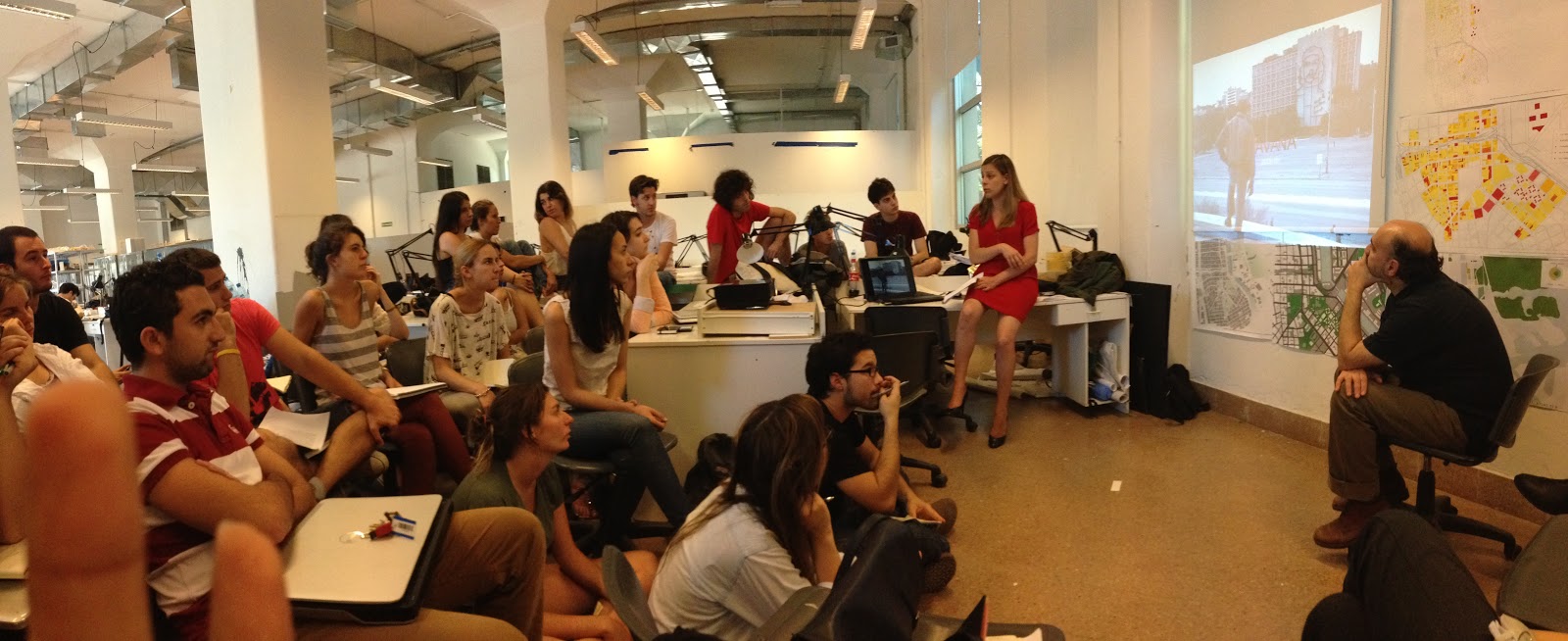
En nuestra viaje con los alumnos de la AA (Inter Unit 8) a Buenos Aires hemos visitado la Universidad Torcuato di Tella.Coemnzamos la visita con una conferencia desde la que presento el trabajo que hacemos desde "Politics of Fabrication" en la Architectural Association. Más tarde los alumnos presentaron en una sesión critica sus trabajos dentro del Taller de Roberto Lombardi y con la participacion de la arquitecta Victoria Goldstein. Entre varios temas se discutieron los problemas de las villas miseria relacionadas con los bordes infraestructurales, el tango y el futbol como actividades culturales que puedan activar el sentido comunitario y la memoria en los distintos barrios de la ciudad, la recuperacion del sentido tradicional de domesticidad a traves de la reintroduccion de los mataderos en la ciudad, y posibles nuevas soluciones de vivienda temporal colectiva relacionadas con los nuevos residentes emigrados. Para finalizar tuvimos la visita del director Ciro Nadjle. 

In our unit trip with AA students (Inter Unit 8) we visited the Universidad Torcuato di tella, where students presented their work in the Roberto Lobamrdi workshop with the participation as critic of the architect Victoria GoldsteinSeveral issues were discussed , such as the slum problem in relation to infrastructural edges, tango and football as cultural activities that may trigger a sense of community and memory in different districts of the city, the recovery of the traditional sense of domesticity through the reintroduction of slaughterhouses in the city, and possible new collective temporary housing solutions related to new residents emigrated. Finally we had the brief visit of the director Ciro Nadjle.

Image by Asaad Bazraa


20.9.12

Politics of Tranformative Block

New academic year in the AA and new brief


POLITICS OF TRANSFORMATIVE BLOCK
Understanding scale through Buenos Aires city grid
This year Intermediate Unit 8 will be working on the design of a mix-used city block to be shared by a private corporation and a public institution in Buenos Aires, Argentina. In Latin-American cities, rapid socio-economic changes are giving birth to unprecedented city block configurations with radical programmatic assemblages, reversibility between inside and outside and interchange between public and private domains. However the possibility of these transformations, that change our understanding of cities as politically controlled entities through policy making, lies in its attachment to a generic urban grid. Being Buenos Aires 100x100m grid one of the densest in Latin-America makes it a perfect scenario to showcase the potential value of the block to generate city today. This implies a complex form finding process reassessing the tension between block and grid, a gradation between permanence and change in buildings, and a constant fight between the stability aimed by the governmental and the inevitable change derived from economic processes. Students will work on a 100x100m urban block using an empty or built plot within the Buenos Aires grid. The structure of the course will be divided in three interrelated parts detecting fundamental aspects for the block design. 1. Operational fields: Research on socio-cultural and economic aspects that will inform the programmatic brief of block proposals. This research will be also accompanied by a reading of the city through a collection of maps, photographs and city fragments that will be used for filling the block with content. 2. Spatial Organizations: Architectural examples of Clorindo Testa in Buenos Aires and urban block proposals by Rem Koolhaas, Hans Kollhoff and Rafael Moneo will be analysed to understand their formal and spatial organizations that will be extrapolated as preliminary systems of spatial relations of block proposals. These diagrams in axonometric will articulate and structure the programmatic content of the block. 3. Active Interfaces: Studies on the transformation, adaptation and responsiveness of the block, reflecting on its relationship with both the grid and the passersby, will be studied through a 1/5 mock-up of the building envelope.


Image: Fragkiskos Konstantatos Intermediate Unit 8 (2011-12): A new transportation hub in Tlatelolco site that combines spontaneous peseros’ network with regulated transportation system as a response to the acceleration of Mexico City socio-spatial fragmentation.