Mi ultimo articulo para La Ciudad Viva," Tecnología es la respuesta, pero ¿Cuál es la pregunta?" discute el uso de las nuevas tecnologías en el diseño de nuestras ciudades, centrándose en la critica a las nuevas ciudades inteligentes de Masdar en los Emiratos Arabes y Songdo en Corea del Sur. Asimismo revisa las opiniones de los sociólogos Richard Sennet y Saskia Sassen al respecto y presenta algunas de las ideas en su linea discursiva desde el grupo de investigación
MIT Senseable City dirigido por Carlo Ratti. Este articulo se encuentra en el siguiente enlace: http://www.laciudadviva.org/blogs/?p=16091
My last article for La Ciudad Viva, "Technology is the answer, but what is the question?" discusses the use of new technologies in the design of our cities, focusing on criticizing the new intelligent cities in the United Arab Masdar and Songdo in South Korea. It also reviews sociologists Richard Sennett's and Saskia Sassen's points of view on the smart cities and shows some of the ideas following their discourse from the research group MIT Senseable City led by City Carlo Ratti. This article is in the following link: http://www.laciudadviva.org/blogs/?p=16091
3.3.13
20.12.12
Septimo articulo para la Ciudad Viva - Silicon Roundabout: Nueva ciudad tecnologica en el este de Londres
Mi ultimo articulo del 2012 para La Ciudad Viva," Silicon Roundabout: Nueva ciudad tecnologica en el este de Londres" presenta y discute el nuevo proyecto del gobierno del Reino unido junto al ayuntamiento de Londres para crear un centro tecnologico en la ciudad. Situado en la rotonda de Old Street, que marca el inicio del barrio de East London, el centro sera uno de los mayores de toda Europa, pero amenaza la espontaneidad del crecimiento de empresas tecnologicas en al zona. Este articulo se encuentra en el siguiente enlace: http://www.laciudadviva.org/blogs/?p=15645
My last article in 2012 for La Ciudad Viva magazine, "Silicon Roundabout: New Technological City in East London" presents and discusses a new project of the UK government and the City of London to create a technology center in the city. Located in the Old Street roundabout, which marks the beginning of East London district, the center will be one of the largest in Europe. However it threatens the spontaneous growth of technology companies in the area. This article is in the following link: http://www.laciudadviva.org/blogs/?p=15645
18.11.12
Politics of Fabrication en Buenos Aires
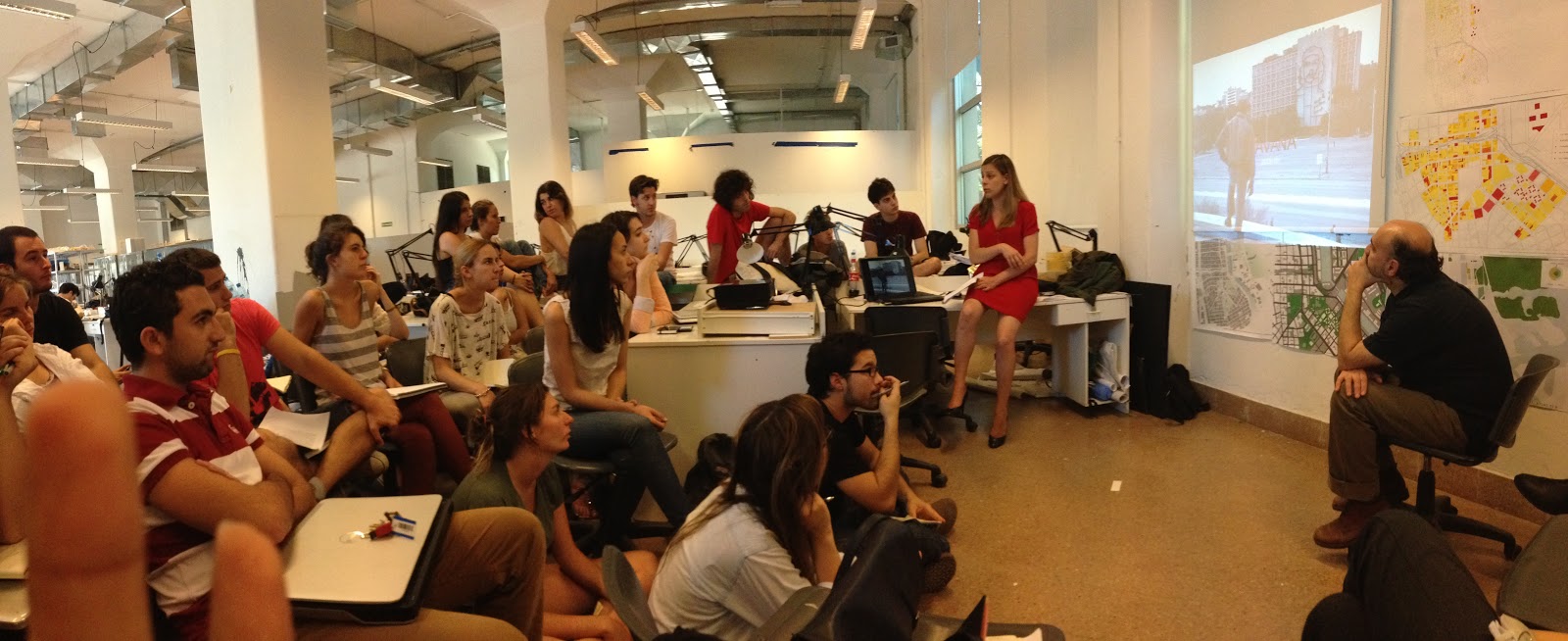
En nuestra viaje con los alumnos de la AA (Inter Unit 8) a Buenos Aires hemos visitado la Universidad Torcuato di Tella.Coemnzamos la visita con una conferencia desde la que presento el trabajo que hacemos desde "Politics of Fabrication" en la Architectural Association. Más tarde los alumnos presentaron en una sesión critica sus trabajos dentro del Taller de Roberto Lombardi y con la participacion de la arquitecta Victoria Goldstein. Entre varios temas se discutieron los problemas de las villas miseria relacionadas con los bordes infraestructurales, el tango y el futbol como actividades culturales que puedan activar el sentido comunitario y la memoria en los distintos barrios de la ciudad, la recuperacion del sentido tradicional de domesticidad a traves de la reintroduccion de los mataderos en la ciudad, y posibles nuevas soluciones de vivienda temporal colectiva relacionadas con los nuevos residentes emigrados. Para finalizar tuvimos la visita del director Ciro Nadjle.
In our unit trip with AA students (Inter Unit 8) we visited the Universidad Torcuato di tella, where students presented their work in the Roberto Lobamrdi workshop with the participation as critic of the architect Victoria Goldstein. Several issues were discussed , such as the slum problem in relation to infrastructural edges, tango and football as cultural activities that may trigger a sense of community and memory in different districts of the city, the recovery of the traditional sense of domesticity through the reintroduction of slaughterhouses in the city, and possible new collective temporary housing solutions related to new residents emigrated. Finally we had the brief visit of the director Ciro Nadjle.
Image by Asaad Bazraa
In our unit trip with AA students (Inter Unit 8) we visited the Universidad Torcuato di tella, where students presented their work in the Roberto Lobamrdi workshop with the participation as critic of the architect Victoria Goldstein. Several issues were discussed , such as the slum problem in relation to infrastructural edges, tango and football as cultural activities that may trigger a sense of community and memory in different districts of the city, the recovery of the traditional sense of domesticity through the reintroduction of slaughterhouses in the city, and possible new collective temporary housing solutions related to new residents emigrated. Finally we had the brief visit of the director Ciro Nadjle.
Image by Asaad Bazraa
20.9.12
Politics of Tranformative Block
New academic year in the AA and new brief
Image: Fragkiskos Konstantatos Intermediate Unit 8 (2011-12): A new transportation hub in Tlatelolco site that combines spontaneous peseros’ network with regulated transportation system as a response to the acceleration of Mexico City socio-spatial fragmentation.
POLITICS OF TRANSFORMATIVE BLOCK
Understanding scale through Buenos Aires city grid
This year Intermediate Unit 8 will be working on the design of a mix-used city block to be shared by a private corporation and a public institution in Buenos Aires, Argentina. In Latin-American cities, rapid socio-economic changes are giving birth to unprecedented city block configurations with radical programmatic assemblages, reversibility between inside and outside and interchange between public and private domains. However the possibility of these transformations, that change our understanding of cities as politically controlled entities through policy making, lies in its attachment to a generic urban grid. Being Buenos Aires 100x100m grid one of the densest in Latin-America makes it a perfect scenario to showcase the potential value of the block to generate city today. This implies a complex form finding process reassessing the tension between block and grid, a gradation between permanence and change in buildings, and a constant fight between the stability aimed by the governmental and the inevitable change derived from economic processes.
Students will work on a 100x100m urban block using an empty or built plot within the Buenos Aires grid. The structure of the course will be divided in three interrelated parts detecting fundamental aspects for the block design.
1. Operational fields: Research on socio-cultural and economic aspects that will inform the programmatic brief of block proposals. This research will be also accompanied by a reading of the city through a collection of maps, photographs and city fragments that will be used for filling the block with content. 2. Spatial Organizations: Architectural examples of Clorindo Testa in Buenos Aires and urban block proposals by Rem Koolhaas, Hans Kollhoff and Rafael Moneo will be analysed to understand their formal and spatial organizations that will be extrapolated as preliminary systems of spatial relations of block proposals. These diagrams in axonometric will articulate and structure the programmatic content of the block. 3. Active Interfaces: Studies on the transformation, adaptation and responsiveness of the block, reflecting on its relationship with both the grid and the passersby, will be studied through a 1/5 mock-up of the building envelope.Understanding scale through Buenos Aires city grid
Image: Fragkiskos Konstantatos Intermediate Unit 8 (2011-12): A new transportation hub in Tlatelolco site that combines spontaneous peseros’ network with regulated transportation system as a response to the acceleration of Mexico City socio-spatial fragmentation.
18.8.12
Resultado Workshop AA Visiting School Politics of Fabrication laboratory Havana
El pasado 17 de Agosto se clausuró la
Escuela Visitante de la AA Politics of Fabrication Laboratory en la CUJAE, La
Habana, Cuba. Los resultados han sido impresionantes con una estructura
finalista construida para este entorno arquitectónico moderno. "El Tercer
Mundo", inspirado en la obra del pintor Wilfredo Lam del mismo nombre, fue
el diseño elegido para el que se utilizaron métodos de diseño digitales, Rhino
y Grasshopper, traducidos a las técnicas tradicionales de construcción de
estructuras tensada. La interesante mezcla de nacionalidades y experiencias
pasadas del grupo de participantes han hecho posible este precioso resultado
que será sede de los talleres de dibujo arquitectónico.
Muchas gracias a la CUJAE, en especial a Ada Portero, a los eventuales
colaboradoes, Maritzia y Dania, y a todos los participantes del workshop: Marta
Falchi, Claudio Campanile, Stavros Papavassiliou, Ursula Mendo, Segio Gonzalez,
Natasa Christou, Osmany Garcia Fuentes, Jorge Contador Caballero y
Ricardo Machado Jardo.
Last 17th of August finished the AA Visiting School Politics of Fabrication Laboratory at CUJAE, Havana, Cuba. The results have been impressive with a final structure built in this modern architecture environment. "The third world" was the chosen design, inspired in the Wilfredo Lam painting, created by digital tools, Rhino and Grasshopper, and translated into a textile tensile structure. The interesting mix of nationalities and backgrounds of the participants made possible this beautiful result, an installation that will host future architectural drawing workshops of the University.
Thank you very much to CUJAE, especially to Ada Portero, the eventual collaborators Maritzia and Dania, and all the participants of the workshop, Marta Falchi, Claudio Campanile, Stavros Papavassiliou, Ursula Mendo, Segio Gonzalez, Natasa Christou, Osmany Garcia Fuentes, Jorge Contador Caballero y Ricardo Machado Jardo.
17.7.12
Sexto articulo para la revista La Ciudad Viva - Hackney Wick: dos formas de entender la ciudad creativa
Mi ultimo articulo para La Ciudad Viva,"Hackney Wick: dos formas de entender la ciudad creativa" explica mi punto de vista sobre como deberia ser el planeamiento urbano para un entorno creativo a traves del analisis de dos diferentes tacticas de actuacion y apropiacion del territorio urbano en el barrio de Hackney Wick. El trabajo de campo me ha proporcionado un conocimiento mayor sobre este interrogante planteado en nuemrosos libros de urbanismo. Pueden leer el articulpo en el siguiente enlace: http://www.laciudadviva.org/blogs/?p=14814
My last article for La Ciudad Viva, " Hackney Wick: two ways of understanding the creative city" explains my view of how could be an urban design proposal for a creative environment through the analysis of two different tactics of act and appropriation of territory in Hackney Wick urban district. The field work has given me a greater knowledge on this question raised in numerous books of planning. You can read this article in the following link: http://www.laciudadviva.org/blogs/?p=14814
Image by Francisco Gonzalez de Canales
29.6.12
Quinto articulo para la Ciudad Viva - El vecindario como forma de produccion de urbanismo
Mi ultimo articulo para La Ciudad Viva,"El vecindario como forma de produccion de urbanismo" desvela el trabajo presentado por el estudio Teddy Cruz (San Diego, California, EEUU) en la AA el pasado mes de mayo en el que se buscan nuevas estrategias urbanas en las que inversion privada y comunitarismo encuentren un dialogo hacia un urbanismo "sostenible". Pueden leer el articulpo en el siguiente enlace:
http://www.laciudadviva.org/blogs/?p=14509
My last article for La Ciudad Viva, "The neighborhood as a form of urban production" reveals the work presented by the EstudioTeddy Cruz (San Diego, CA, US) at the AA last May. In this office the architect Teddy Cruz and his partners look for new urban strategies in which private investment and communitarian organizations will find a dialogue towards a "sustainable" urban planning. You can read on the following link:
http://www.laciudadviva.org/blogs/?p=14509
Imagen de la conferencia de Teddy Cruz en la
Architectural Association, Mayo 2012
Subscribe to:
Posts (Atom)

.jpg)

+copy.jpg)
_2.jpg)